
Episode #248
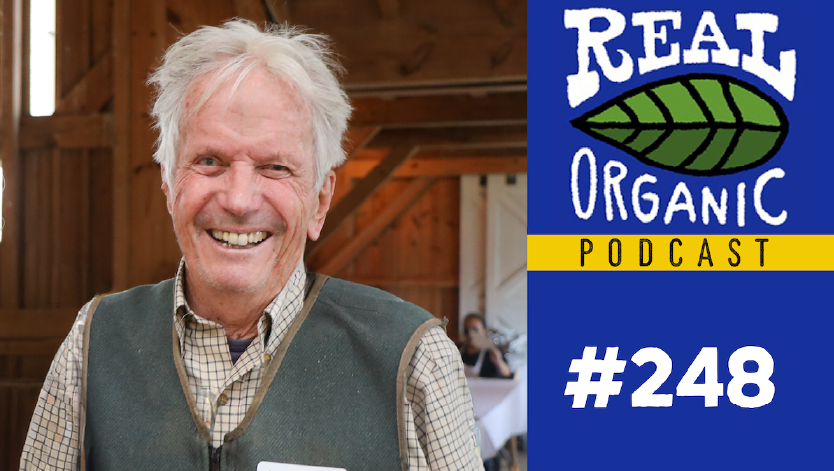
Hugh Kent: Saving A Real Organic Farm Through Direct Marketing
At the Saving Real Organic conference at Churchtown Dairy, Hugh Kent, co-founder of King Grove Organic Farm in Florida, shared the powerful story of how he and his wife, Lisa, refused to let their organic blueberry farm be crushed by monopoly control and USDA neglect. In a talk that blends economics, law, and lived farming experience, Hugh explains how corporate consolidation, fraudulent hydroponic “organics,” and illegal plastic-based production systems have destroyed fair markets for soil-grown farmers. Yet his story turns from outrage to hope: through direct marketing and the support of the Real Organic Project community, the Kents rebuilt their farm, found their customers, and proved that real organic farming still has a future – if we take it back.
Our Hugh Kent talk was recorded live on stage at the Saving Real Organic Conference at Churchtown Dairy on September 27, 2025:
You can subscribe and download episodes of our show through your favorite podcast app, our YouTube channel, or stream the audio-only version here:
Hugh Kent live on stage at Churchtown Dairy, September 27, 2025:
Linley Dixon 0:01
Our next speaker is a farmer, but I got to travel the country for the Real Organic Project in that first year and met so many highly educated farmers. This farmer also has an economics degree, and he has a law degree from Cornell. He has a lot of credentials to be talking about antitrust.
Linley Dixon 0:25
In that first year, when we were trying to figure out what we were going to be called, what our logo was going to be, Hugh Kent just started using the label on his products, and to this day, it kind of looks like a blueberry. Hugh and Lisa Kent farm those famous blueberries at King Grove Organic Farm in Florida, and Hugh Kent is going to be talking today about how he saved his farm through direct marketing.
Hugh Kent 0:48
I’m looking forward to getting to the positive part that Austin Frerick just ended with, but it’s going to take me a little while to get there. If you’ll forgive me, we’ll go through some uncomfortable realities first. One of them is that if you want free and fair markets, if you want the free market that our political leaders tend to revere in their public comments, you actually have to have some regulation on it.
Hugh Kent 1:40
Free markets and unregulated markets are not the same thing. If markets are entirely unregulated, we end up with things like we’re seeing now: monopolies, oligopolies, price fixing, restraints on trade, and racketeering. That’s what’s allowed to gain a foothold in totally unregulated markets.
Hugh Kent 2:05
When we talk about that kind of thing in agriculture, it looks a little bit different. But that’s my message for today: if we want all of the good things that free and fair competition bring us, we need to have some regulation, and it needs to be fairly and evenly applied.
Hugh Kent 2:31
I’m going to tell you a personal story. My wife, Lisa, and I are introverts, and we do this nervously and with some apprehension. But I think the best way to illustrate how antitrust problems are manifest in the agricultural industry is to tell you the story of our farm.
Hugh Kent 2:56
We farm blueberries on 20 acres in the middle of land that we steward, which is woodlands, wetlands, and wildlife around our farm. But the active crop is 20 acres of blueberries. To give you an idea of the scale, that’s a medium-scale farm. I do believe that what JM Fortier has been able to do, and what he promotes, is the gold standard for agriculture.
Hugh Kent 3:24
But for some of us, we strive for kind of a silver standard, because we don’t live in communities that support us to the extent that JM does and has been able to create. If we live in areas that don’t have that kind of community, we have to reach out to a larger community, and we may have to do something like Lisa and I chose to do, which is to be wholesale farmers.
Hugh Kent 3:45
That means, as a medium-scale farm, we can’t survive going to farmers markets. A farm our size, if we put all the rows together, would be about 17 miles, and there’s a plant every two and a half feet. We produce somewhere between a quarter million and a half million of those little plastic clamshells you’re used to seeing in the store in about an eight to ten-week period.
Hugh Kent 4:09
That’s not something that we can sell in farmers markets. We have to go to the wholesale market. That was what we conceived of from the beginning – we were going to be small wholesale farmers. We started out with all sorts of hope and optimism. There’s our farm when we first planted it. We were committed to organic agriculture.
Hugh Kent 4:33
We learned as best we could from a lot of the people in this room, and we developed a system that’s worked very well. As far as our production goes, we’re very pleased with it. From maybe two or three years in, we figured it out pretty well. We grew a good crop and concentrated on stewardship of our soil, as real organic farmers do. We regularly produced higher yields than the average conventional farms in Florida.
Hugh Kent 5:11
Then the question became, “Well, how do we sell this product that we think is very valuable and healthy – healthy food for people?” We went into the wholesale market. I’d like to explain to you how this works. Please keep in mind, this is just an illustration that I’m making using blueberries. But of course, I could do this with tomatoes, peppers, greens, or herbs. There are many crops I could apply the same story to.
Hugh Kent 5:41
Farmers are basically manufacturers. We understand what our costs are and what it takes to create our widgets, but we’re not allowed to set the price. This is a really unique thing in the business world. Wholesale farmers are not able to say, “This is what we will accept for the price of our product, and will you buy it? Will you sign a contract?”
Hugh Kent 6:06
None of the stores will do that. None of them. They won’t even give you any kind of letter of commitment. They really won’t even give you a verbal commitment. Now the consolidation has reached such a point that they won’t even talk to you. They won’t deal with you. They will deal only with these middlemen. These are marketers.
Hugh Kent 6:22
The marketers do not take title to the crop. They don’t take any risk. They don’t do much work. They carry a phone around in their pocket and ask you to sign contracts where you don’t get to see who they sold the product to or how much they sold it for. At the end of the season, they give you a statement that says, “Here’s what we say we sold it for, minus our commission that you agreed to. Maybe we’ll see you next year.”
Hugh Kent 6:55
I collected a bunch of these contracts. That’s an example of one of them on the screen. They’re all the same. None of them will allow you to establish even a floor on the price. Not at all. Every one of them has the same language. They will set the price. You will not complain about it. You have some federal rights under the PACA laws, but you waive most of those under these contracts also, and these are take-it-or-leave-it.
Hugh Kent 7:23
After doing this for three years and receiving pittances at the end of the year, Lisa and I realized this was a great way to go out of business. We said, “No, we’re not signing that. I’m sorry. I can’t sign that. We need some sort of commitment on a minimum price.” “Well, sorry. Good luck selling your blueberries, Mr. Kent.”
Hugh Kent 7:42
That’s what we did – or tried to do. We created our own label and hit the pavement. The limits of time and basic believability keep me from telling you what that was like. But you cannot be even a medium-scale farmer and get into any of the stores in this country at the moment. Even the ones that put on their websites that they will only deal with farmers and not with middlemen – it’s not true.
Hugh Kent 8:10
They have one or two buyers out in California. They won’t talk to you unless you can provide them with berries throughout the domestic season, which means you’d have to have a farm in Florida, Georgia, North Carolina, New Jersey, Michigan, and the Pacific Northwest, so that you can supply them throughout the entire year. Otherwise, they won’t talk to you.
Hugh Kent 8:28
A few years ago, Whole Foods was an exception, and we sold to Whole Foods for six years. Each year, they wanted a little less, and each year, they required a price cut. For six years, we got less and less money selling blueberries to them. When they were purchased by Amazon, that pretty much ended the relationship. They weren’t interested in the amount of volume that we could produce.
Hugh Kent 8:54
We had built our way up to being the exclusive supplier for their Southeast distribution center, which meant that everything we produced in that window, they would take all of their needs from our farm while we had fruit to sell them, and we sold maybe a third to a half of our crop to them for one year there. Then that disappeared.
Hugh Kent 9:20
We were wondering why the prices were so low. We all know who Big Blueberry is. We saw a different type of blueberry entering the market, also labeled as an “organic blueberry,” but it was a very different production system. This is a farm exactly the same size as ours, and it’s plastic hoop houses over plastic.
Hugh Kent 10:00
The field was laser-leveled and compacted, and plastic was placed over every square inch of it, which makes it unsuitable for farming, of course. Then plastic pots were placed on it with a substrate of some kind put in the pots, and little IV tubes provided fertility fertigation into the plastic pots covered with plastic hoop houses.
Hugh Kent 10:26
There are the IV tubes – so it’s a big plastic sandwich. USDA Organic, right? That’s one of their blueberries. That’s the packaging: USDA Organic. This is one of our blueberries, our packaging – indistinguishable on the shelf. Both say the same thing. The consumer or customer would say, “Well, give me the cheaper one.”
Hugh Kent 10:50
This is now the predominant system throughout the world. This is the Central and South American system, and it’s evolved a little bit. Those are grow bags, those plastic bags, that’s coir, coconut husks that come from Sri Lanka, around the world, to lay on top of plastic weed mat. They’re rehydrated. They’re compressed to about a fifth of their size for shipping into these bricks.
Hugh Kent 11:16
Then they’re rehydrated. They fill up the bag. A plant is placed in there, and the fertigation tubes are placed in, and there you have an instant organic farm. The USDA ’s position is that this is the soil, that that coir, that coconut husk comes from Sri Lanka, and so if you don’t put any unapproved substances in there, that’s organic.
Hugh Kent 11:44
I would argue that this defies the law that the USDA is supposed to uphold. That’s why they exist. The NOP exists to enforce the law. That’s their job. The law is very specific about what we’re supposed to do, maybe fifty-some-odd references to soil stewardship. I’ll get to the really specific violations in a minute. But the general one is plain, I think, to any thinking person.
Hugh Kent 12:14
We’re supposed to maintain or improve the physical, hydrological, and biological features of a production operation, including soil, water, wetlands, woodlands, and wildlife. If we go through this really quick, that’s the kind of thing a real organic blueberry farm does. Soil is the focus of most of our work. This is the soil in a USDA organic blueberry farm that produces the vast majority of organic blueberries on the shelf.
Hugh Kent 12:52
Water – when we irrigate or it rains on our farm, the water goes down through a very clean operation. It goes through, in our case, a hundred feet of sand filter, basically, till it hits the static water table. I would argue it’s cleaner when it gets down there than when we started with. I’m not sure what happens with the rainwater that falls on farms like this. I’m pretty sure it runs off very quickly. If it doesn’t, it leaches through the plastic, and those plastic leachates get into the groundwater at some point.
Hugh Kent 13:29
Wetlands – we manage our wetlands in part because we want to create as much life as we can, not just below ground but above ground. That is the primary focus of our pest control program, which is to have a nursery for all of the beneficials. I believe almost everything is beneficial if it’s in balance with the rest of the farming operation.
Hugh Kent 13:48
We have ephemeral wetlands that allow a nursery for all kinds of beneficials that you can actually see. That’s the wetland for that farm. It’s the receiving pond down there at the bottom, which receives leachates and whatever fertigation elements are not taken up by the plants.
Hugh Kent 14:11
Woodlands – same kind of thing. We’re managing woodlands as part of our farming system, as we’re required to do by law. Woodlands, I have nothing to show you here. Wildlife – same. It’s very much a part of our farming system to try and achieve this ecological balance. Again, here, I’m not really… maybe some of these. I hope you weren’t expecting any new jokes. It’s only been a year.
Hugh Kent 14:52
In a more direct and indefensible way, here is the specific language that’s being violated. I can’t quite read that. All right. “For a farm to be certified under this chapter, producers on such farms shall not use plastic mulches unless such mulches are removed at the end of each growing or harvest season.” I would point out this is not a regulation that the USDA promulgated; this is actually the federal statute.
Hugh Kent 15:28
This wording predates the work that the USDA did. They have very similar language. I can show you §205.206–207 CFR, which reflects this in the USDA regulations. It says basically the same thing. But this is a higher-order law. This is passed by Congress. It would take an act of Congress to change this.
Hugh Kent 15:52
You cannot do this. It’s prohibited unless these ground covers, these mulches, are removed at the end of each growing or harvest season. It’s a totally illegal system. Now there’s an exception here if you remove it, and that’s a carve-out for the vegetable guys. There are all kinds of good reasons for them to have that. It makes a lot of sense. It’s a different kind of plastic. It’s a whole different discussion.
Hugh Kent 16:14
But it’s irrelevant here. We’re talking about a perennial crop, and it says you can’t do this. Well, how do you think the USDA gets around this? Their position at the NOP – they say, “A growing season is the lifetime of the plant.”
Hugh Kent 16:34
So if it’s a blueberry plant, fifteen years growing season, maybe, I don’t know, thirty years or something, what kind of farmer believes a growing season is defined as fifteen years? What kind of layperson on the street would not laugh in your face if you said, “Yeah, we have a fifteen-year growing season”? But that’s the level to which they’re torturing their own laws rather than abiding by their own laws.
Hugh Kent 17:00
This is what we’re up against. This is the base, this is the foundation for this organic blueberry system, which operates in Central and South America and is now producing most of our blueberries. You’ve seen some other pictures of the scale of these kinds of things. They’re enormous. They fill entire valleys.
Hugh Kent 17:24
What are the consequences? This one’s really sobering. If you look at the bottom graph – this one’s too far away, and this one’s too close – but I don’t need reading glasses. All right, it doesn’t really matter. One of them is a comparison of Michigan and Peru, and the other one is Florida and Mexico. The little bar graphs at the bottom, that’s the domestic production. I believe the top one is Michigan.
Hugh Kent 18:00
It used to be a big blueberry-producing state. There’s where they are, sort of petering out. That nearly vertical line is Peru. That’s what’s coming into this country. Then in the bottom, there’s the Florida industry in yellow, and Mexico is that nearly vertical line going up. This is 2022 data. For some reason, they’re not publishing the data for 2023, 2024, or 2025.
Hugh Kent 18:38
I think you can guess from the shape of those lines what it looks like now. I’m not sure what our policymakers are thinking, but I think this is also a national security issue. We’re not growing our own food. By the way, those were conventional farms.
Hugh Kent 19:00
Those two graphs – Michigan and Florida; Mexico and Peru – that’s a collection of both organic and conventional. Because these guys that are growing in Central and South America, and they’re bringing in all this organic crop, they’re driving down prices for conventional also. Why should I buy your conventional if organic is this cheap? You have to be below that.
Hugh Kent 19:23
These are soil-based conventional farms in this country that are going out of business also. If you look at these lines, the blue one is how much of our fruit we are importing. The bottom line is our vegetables. I’ve never come across any kind of USDA press release where they haven’t told me that we’re feeding the world, but I don’t know what kind of gaslight they’re reading their statistics by, but these are USDA graphs also. I didn’t make these up; this is USDA data.
Hugh Kent 20:08
This stopped being reported. We are now importing more than 40% of the vegetables we consume in this country. We’re not feeding ourselves. We’re not coming close to feeding ourselves. We’re importing more than 60% of the fruit that we consume in this country.
Hugh Kent 20:31
We see these production systems, and we became curious about them because we’ve been told that our berries taste very different from these hydroponic berries that are taking over. We think they taste different for a number of reasons – how they’re grown – and we think their nutritional value probably reflects their flavor also. We’ve noticed that the quality of food, like all of us have, has just been spiraling down.
Hugh Kent 20:57
We decided to do some testing with the support of the Real Organic Project. We tested for flavor. I’m going to be talking about this after I’m done talking here. But I do want to let you know basically what happened when we took a very small sample, in which we tested for flavor, pesticide residues, and for plastic residues.
Hugh Kent 21:23
Looking at these farms and thinking, “Oh, my God, there’s got to be some plastic residues going somewhere – certainly into the groundwater – down in those areas where they’re being grown like that.” We suspect maybe even into the food.
Hugh Kent 21:24
So, what we found was that – doing a taste test with two-star Michelin chefs, a blind taste test – the Real Organic blueberries were easily at the top, the middle were conventional soil-grown, and in a distant last place were hydroponic organic berries from Mexico and Peru.
Hugh Kent 21:54
There was no question about it. These guys sat around the kitchen. The first question they asked was, “Well, which one’s the worst?” That was very easy. All the hands went up, “Okay, number one and number six, those are the two hydroponics ones.”
Hugh Kent 22:03
When we sent them out for pesticide testing, the Peruvian ones came back clean. The conventional ones, as you would expect, had fungicides and other pesticides on them. The dirtiest one of all was the Mexican hydroponic organic from Mexico, by far, and we have some pesticide experts here who’ve told me that some of the stuff on those were actually things you really should worry about.
Hugh Kent 22:34
I think maybe that justifies some more testing. Certainly, the USDA is not doing it, and maybe this is an organization that can do something like that as a pilot program – and potentially as something that would apply to all of the certified ROP farms.
Hugh Kent 22:47
Here’s the optimistic part of the program. I should have been given a little more time, but I’ll go through it quickly. Lisa and I realized it was a complete dead end. There was no way we were going to get into the wholesale markets and survive. We said, “Well, we’re too big a farm. We can’t sell direct to people.” But we did. Over a five-year period, we went from 100% wholesale to, this last year, 100% retail, directly to people.
Hugh Kent 23:26
It was largely a result of the support from this movement, and then it branched out. We now have customers who care about all kinds of things, from flavor to nutrition to environmental stewardship. But it really started here. It starts here with the support of this group. We had no expertise, we did not lay out the farm that way, we had no plans to do it, and we didn’t know how to run something like that. There were really just two of us working on it, without a whole lot of resources.
Hugh Kent 23:53
Everything was done from scratch, everything was done on the fly. It can be done. As we watch food get commoditized and the quality gets worse and worse, the opportunities for selling direct to people who care are getting greater and greater every day.
Hugh Kent 24:10
We created our own little packing system, believing that fresh air and sunshine are the greatest sanitizers, and they’re the nicest place to work. We did not use the model that packing houses for berries use commercially, which are like meat packing places. It’s recirculated, refrigerated air. We felt vindicated when COVID hit right then.
Hugh Kent 24:30
Every year, even when there isn’t a pandemic, everybody working in that 55-degree environment with recirculated air gets sick. None of our people get sick. Lisa gets 100% on food safety every year. We do all of our own packing right on the farm. We do the refrigeration on the farm. We have something sort of like the Masters, where you get the green jacket. This is our best-performing person of the week.
Hugh Kent 24:59
We’re inspired by the coveted pink “go into the cooler and stay nice and warm” jacket. He wins all the time, unfortunately. This is the little facility we built, and we ship directly out of there. We take a truck to UPS, and we unload right into their system, and everything is delivered by UPS.
Hugh Kent 25:23
I would argue this may be a more efficient way of selling and transporting than we used to use. We used to sell to a restaurant, for example, and it would go through several hands. We would have to package them up in those plastic clam shells to satisfy the distributor. It would go on less-than-full-load trucks.
Hugh Kent 25:39
The doors would open, they would close. They would travel all over the place. They go to a distribution center, then they go to another. When they finally get to the restaurant, the guys would take all of these plastic containers and throw them in the dumpster as they emptied each one to get a pile of berries that they could use.
Hugh Kent 25:53
We sell to people now for food service. We sell to professional sports teams that want the nutritional quality. There’s our product leaving our farm. Nobody touches it except for us and the people who eat it. We’ve learned over the years those are the only people who really care about quality.
Hugh Kent 26:13
I think this is very significant. This is just an illustration of what we did. We started there. The blue represents our direct-to-retail customers. In just five years, we went from a small percentage up to one hundred percent.
Hugh Kent 26:41
The applause is for you. This is a really interesting graph. This is people who bought groceries using e-commerce. This was for July, last month. The August one looks even more impressive. We didn’t have time to get it on air. But those three represent direct, pickup, and ship to home. This is the people who compile this data. That’s the labels they use.
Hugh Kent 27:14
Direct is when Instacart or somebody delivers it to your home. Pickup is when you go to the store and you pick up a pre-order. Shipped to home is what we do. The one on the far right, that’s what we do – the little red one that’s growing quickly. They’re all growing quickly. This is exploding. But that’s 1.6 billion in one month that was shipped to home. The same kind of work that we do.This is very, very viable.
Hugh Kent 27:44
I would argue that until we get the wholesale system straightened out, this is the way that we can feed our families healthy food, and it’s the way good farms can keep going. I don’t know if this is the last time I’ll address you as a farmer. I think Lisa and I maybe will have a harvest in the spring, but we’re getting near the end of the road for ourselves.
Hugh Kent 28:08
But we certainly look forward to passing along with you everything we’ve learned, and we think that, again, we would like to be a resource for anybody who would like to try what we’ve done. Thank you again for helping us so much, and we hope to do the same for the movement.
More Podcasts
View All Podcasts ➔